After three months of Zimbabwean cuisine (which excels itself on seasonal vegetables and pots of unidentifiable stew) I was ready for an injection of food that punches more flavour than the said boiled veg.
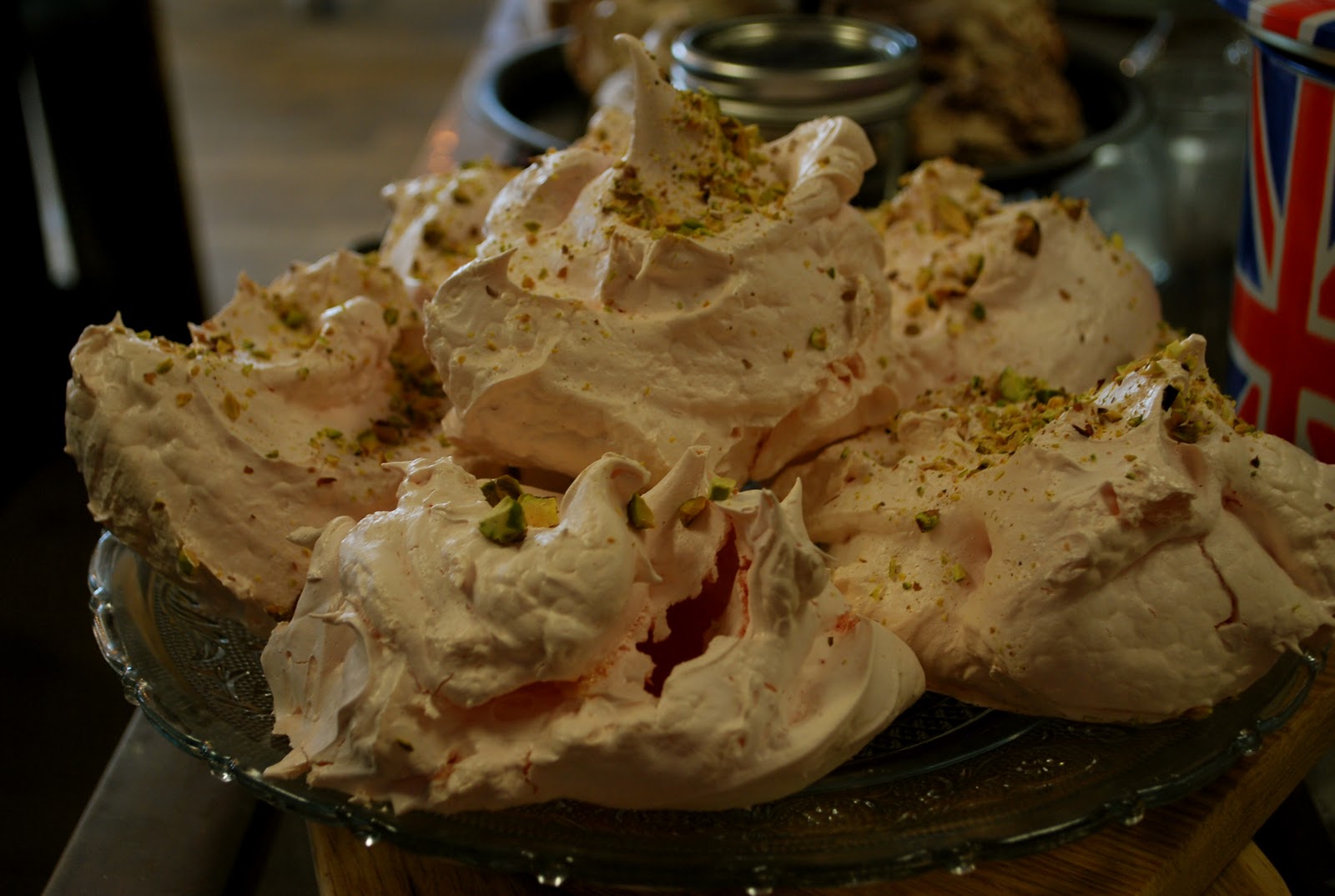
A 12 hour bus ride and 2 hour flight brought me to Cape Town and the launch of my wonderful friend Sonja’s brand new venture. May I present The Larder Café, Deip River. A gorgeous couple of weeks was spent sculpting pink meringues, curing beetroot gravalax and marinating olives in a bid to help lift off.
The décor is retro and rustic; towers of Lyles Golden Syrup sit next to faded records and homemade jars of plum jam. Mix matched tables sit right next to the tiny open kitchen. As a punter you’re able to watch the cakes roll out of the oven while you wile away your cappuccino.
The menu salutes local, fresh produce that has laboriously been sourced from the individual farms and my goodness, you can taste it. The yogurt taught me how it’s supposed to taste.
So whether it’s coffee, killer carrot cake or a healthy salad you’re after, do take a moment to drop by, Sonja will be there with a bow in her hair, waiting to welcome you in.
There is no denying it, this was the smartest apartment I've stayed in. Not that I paid for it, no, it was a review for a fantastic travel website called I-escape.
Reviewing hotels, now that is something that I could imagine getting into.
It is only on approaching the chicken houses that a musty, organic smell seeps through shiny wire and threatens to stop you in your tracks.
Life begins in a hatchery where eggs are cautiously warmed and turned until the chicks are ready to fracture their fragile houses. They burst, tiny and bare-bodied with only an embarrassingly poor excuse for feathers stuck to the skin but each baby, nobly fighting for survival. With every day the birds grow stronger on our African soil, breathing in the sun, inhaling their feed and scrabbling in red dust. My neighbours seem happy, if a little odorous.
Our house rations proffer three chickens a week. There is a certain satisfaction knowing the chicken has travelled just two hundred yards to its waiting roasting tin.
Yesterday I quartered thirty ripe tomatoes and peeled eighteen cloves of garlic. They sat making friends for more than six hours. I ground more pepper than was needed, picked some basil from the patch and added it to the tin.
A sharp knife sliced the chicken into eight and a hot frying pan branded the skin golden. The oven was set to high and the tomatoes sat, covered for just under sixty minutes. I fried three onions, which incidentally made me cry far more than their English counterparts, and stirred them through the broken tomatoes. The golden chicken was rested on top and the whole lot returned to the oven for its final few minutes. More salt, more pepper, more basil.
My farm recipe tasted fresh and simple and we ate commenting, more than once, on the smugly small carbon footprint.
I’m not sure I’ve encountered a mulberry tree before and I expected it least in sunny Zimbabwe. But a burgeoning tree, its branches sagging with the weight occupies the bottom of our new garden.
Daily visits reveal new dripping gems and facing my snake fears – we are advised they like the shady undergrowth of trees - a fight begun between the humans and the hostile birds who defend their sweeties. Naturally, we both win. The birds swooping to gather any fallen orphans and we stuff vessels with ours handpicked, skipping to the kitchen.
So what does one do with mulberry hoard after mulberry hoard?
We ate them sugared, simmered, sitting atop of sponge, squashed into an berry smoothie, riding pancakes and the piece de resistance, frozen into mulberry and vanilla ice cream. No mean feat when all you have is an African freezer and one Tupperware box.
Apologies for the slight pause in posting. We've been upping sticks, moving to Zimbabwe and finding our feet on a chicken farm. Still, we're here and we've settled in but the journey was quite a story.
N writes;
“If you could do this for me I will give you both a kiss on the mouth”
“What kind of puppies are they, Ezra?”
“I’ll leave that as a surprise”
I (a junior doctor) and Georgina (a food stylist) were less than twenty-four hours into our year in Zimbabwe and had already been coaxed into transporting two, 6 week old puppies of unknown breed or size, the 450km from Harare to Bulawayo.
We arrived at the house in Harare and I piped into the intercom at the gate “Hi it’s Nick and Georgina here to pick up some puppies for...” I was cut short as a white Zimbabwean voice interjected “Yup, that’s fine. Come on through but stay in the car, just stay in the car!”
Few things are certain in Zimbabwe but one undeniable truth was that Ezra had a penchant for big dogs and was already the proud owner of two, enormous Boerbull-Rottweiler cross. This fact combined with the shot across our boughs (and, frankly, my bowels) via the speaker lead us to the conclusion that potential death lead ahead, not just for us but also our little Kia Picanto which was sure to be dwarfed by the monsters within.
The gates opened and the barking began. It grew louder and louder and louder still and yet we still couldn’t see the beast. The reason for this was that all the noise was coming from a rather average-sized (but nonetheless spirited) miniature dachshund that was swiftly joined another (presumably it’s mate and the mother of the puppies).
Surprised by Ezra’s change of heart and feeling slightly sheepish for our own fear we stepped out of the car with calming words of “Hello doggy. How are you? Yes yes yes. You’re a good doggy aren’t you!”
Then the ground began to shake. Mummy and Daddy were charging across the lawn and didn’t look like they were a) particularly pleased to see us and b) likely to be amenable to the kind of canine niceties we had been purring at the dachshunds.
I (showing distinctly less resolve than Georgina) started pawing feverishly and the car door which suddenly seemed quite complicated to operate but nevertheless managed to dive into the air-conditioned safety of the hire car. Soon after I was face to face with the growling jaws of two, enormous Boerbulls.
Few things are certain in Zimbabwe but one undeniable truth was that Ezra had a penchant for big dogs.
After a slightly emotional/terrifying goodbye from Mummy dog in particular we left Harare and headed south with two, utterly adorable Boerbull puppies. Seven hours later after three water stops, two in-car defaecations and one change of clothes for Georgina post-puppy travel sickness, we arrived in Bulawayo.
Our African adventure had begun and had successfully avoided becoming a dog’s dinner.
Our children will be 1/8th Faroese. My husband has the island's blood running through him so in a concerted effort to learn of our heritage, we embarked on a somewhat haphazard journey to the Isle. Sheep, grass, turf roofs, death educing cliffs and grey seas greeted the tarmac touch down but it was only once we discovered the local food that I felt I was learning.
Look above. From left to right we had Opsi fishcakes, skerpikjøt (dried sheep meat), Whale blubba, boiled potatoes, dried Whale meat and sea dried fish. Each was an unknown taste to me and although each is thought of as a delicacy, each independently made my stomach feel a little delicate.
The climate dictates a diet rich in meat and fish but vegetables aren’t able to survive the hash climate and lack of sun. The result is tables laden with mutton, herrings, eggs, whale and on a good day, puffin. Mr Atkins, you have found your refuge.
I knew it was cheap but 1.2 kilo of pork belly for a mere wafer of five pounds? The little blighter was cooked for three hours until the the blistered skin was broke like an icy puddle and the fat had rendered to glorious slush. Fennel, celery, rosemary & onion were added for the final run in the oven, cooked until just soft.
FENNEL & ROSEMARY MELTING PORK BELLY
Serves 4 - 6
Prep Time – 10 minutes
Cook Time – 3 ½ hours
INGREDIENTS
1.5kg boneless pork belly
1 tbsp sea salt
Cracked black pepper
1 tbsp rosemary, finely chopped
1 tbsp oil
1 red onion, peeled and cut into quarters
6 garlic cloves, peeled and cut in half
2 fennel bulbs, cut into 1cm slices (2?)
3 sticks celery, cut into big chunks
400ml chicken stock
DIRECTIONS
1/ Preheat your oven to 220C, fan 200C, gas . Using a sharp knife score skin of your pork belly in diagonal lines approximately 1 inch apart, taking care to only score the fat and not cut into the meat. Rub the sea salt and rosemary deep into the fat and season with black pepper. Drizzle with olive oil.
2/ Place the belly in a roasting dish, big enough for the meat to lie flat and roast for about 30 minutes at high heat. You will see the skin start to crackle and become crispy crackling. After 30 minutes turn the heat down to 180C, fan 160C, gas 4 and roast for a further hour.
3/ Remove from the oven and carefully place the belly on a board. Tip all the vegetables into the roasting tin and smother with the fat. Place the belly back on top of the vegetables and roast for a further 1 – 1 ½ hours. The pork is ready to serve when its deliciously tender and almost falls away to the touch.
3/ Roast for 30 minutes before reducing the temperature to 190C, fan 170C, gas 5. Pour the wine and stock into the roasting dish, being careful not to pour he liquid on top of the crackling. Cook for 3 hours?.
4/ Once wonderfully tender remove the pork from the tin and cut into chunks with a sharp knife. Serve with the braised vegetables and a dollop of crème friache.